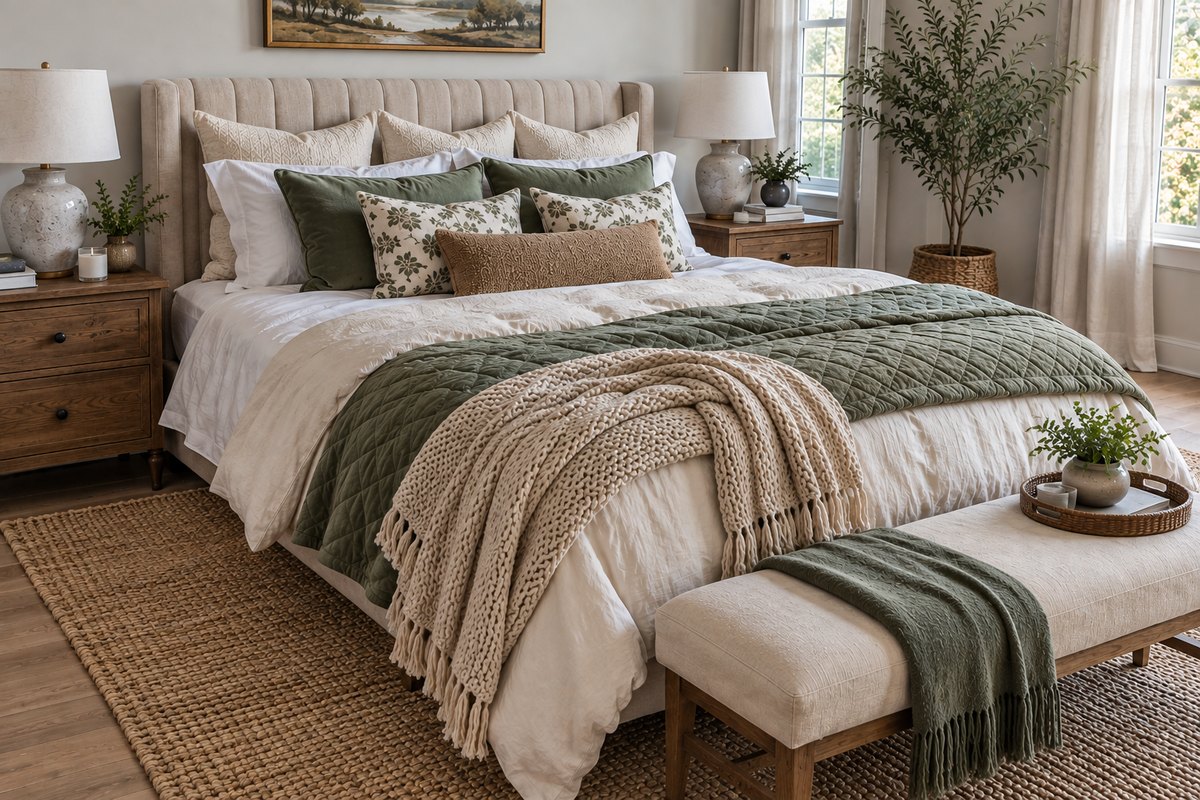
Every September I strip the bed, put the summer linen away, and end up in the same place. I try something new, I strip it again, and by the end of the week it's back to this.
Cream, sage green and oatmeal. A fluffy duvet, a quilt folded at the foot, a chunky knit throw I can pull up on a cold night, and a stack of pillows that looks a little more generous than it needs to.
It isn't complicated, and that's the point. Here's the whole combo, layer by layer, how I put it together, how I arrange the pillows, and four other fall bedding combos if sage isn't your color.
The fall bedding combo, layer by layer
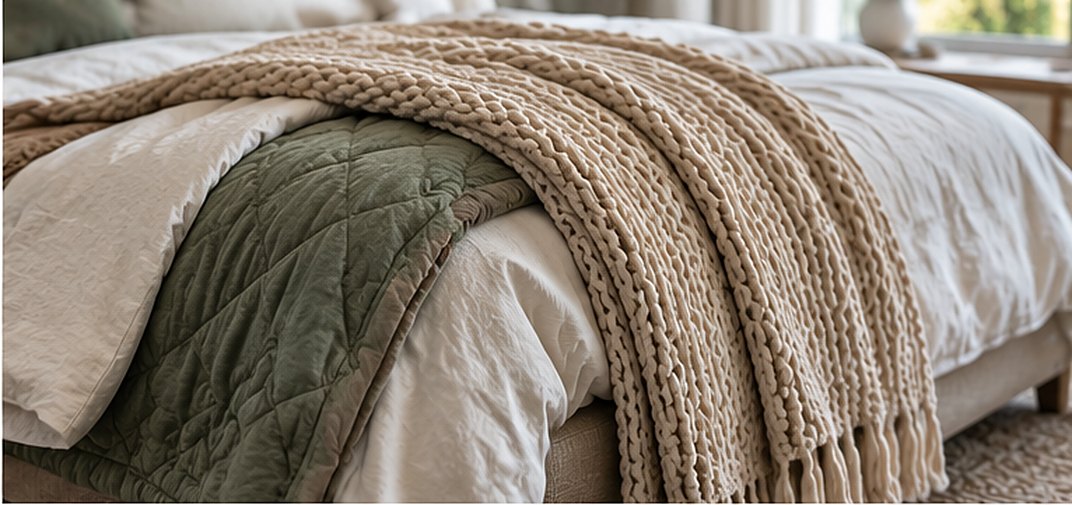
From the mattress up, this is the whole bed:
- Crisp white sheets. Cotton percale in early fall, when nights are still mild. I switch to flannel or brushed cotton when it really gets cold.
- A cream duvet. A down or down-alternative insert in a cream cotton or linen cover. Cream instead of bright white makes the whole bed feel warmer.
- A sage green quilted coverlet, folded in thirds across the bottom of the bed. This is the color layer, and it adds weight without much heat.
- A chunky oatmeal knit throw, draped loosely over one corner. It's the texture everyone notices, and the first thing I grab on a cold evening.
- Pillows in four sizes, in cream, white, sage, a small green floral and one tan lumbar.
Everything else in the room is quiet: a cream upholstered headboard, wood nightstands, simple ceramic lamps, a jute rug and a bench at the foot of the bed.
Why cream, sage and oatmeal work for fall
A lot of fall bedding goes straight to rust, mustard and plaid. It looks great for about three weeks, and then it starts to feel heavy.
Sage green does the job more gently. It reads as fall next to wood and oatmeal, but it doesn't clash with anything else in the room, and it carries right through winter into spring. Cream keeps the bed bright, and oatmeal and tan add warmth without adding another strong color.
It also photographs well in the soft light you get in September and October. That's one reason it keeps turning up on Pinterest.
How to layer bedding for fall
Layering is what makes a bed look inviting instead of flat. Here's the order I use, and why.
1. Start with a flat sheet, tucked well. Tuck the bottom and sides tight, and fold the top edge of the flat sheet back over the duvet by about 12 inches. That white band at the top is what makes a bed look hotel-made.
2. Add the duvet or comforter. Shake it so the filling sits evenly, then let it hang an even amount on both sides. If you have a bed skirt or a platform frame, the duvet should cover the side rails.
3. Fold a quilt or coverlet across the foot. Fold it in thirds lengthwise and lay it across the bottom third of the bed. It adds color, protects the duvet from shoes and pets, and gives you an extra layer to pull up on cold nights.
4. Drape a throw. Don't fold it perfectly. Let a knit or waffle throw fall over one corner, or across the quilt at an angle. It should look as if someone just got up.
5. Finish with the pillows, biggest at the back and smallest at the front.
On a warm September night, the quilt comes off and the throw goes on the bench. By November, everything stays on the bed.
How to arrange pillows on a bed
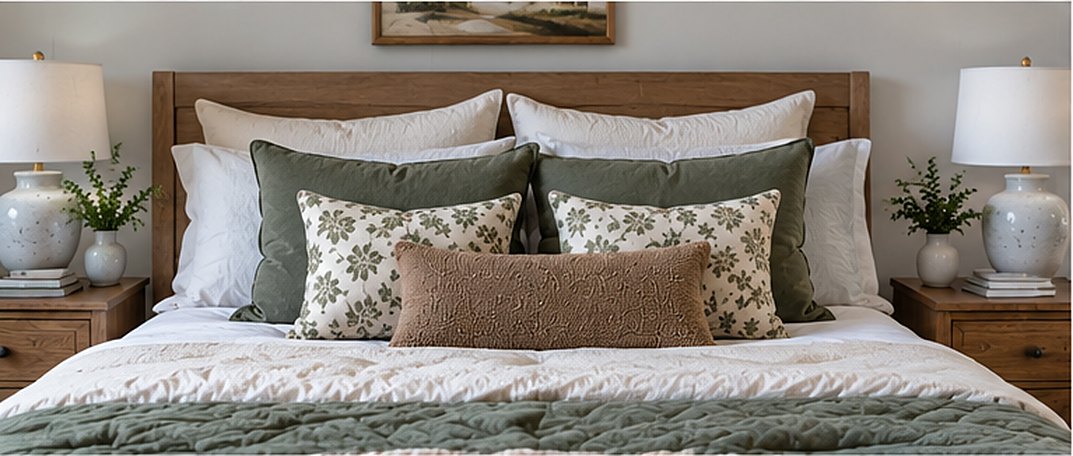
The pillow stack is where most beds look either sparse or overdone. I use five rows, from the back to the front:
- Euro shams, the big square 26 x 26 inch pillows, standing against the headboard. Use two on a queen and three on a king.
- Sleeping pillows in white cases, standing up or lying flat.
- Standard shams in a color, here sage green velvet. Two on either size of bed.
- Two smaller accent pillows, around 20 x 20 inches, in a pattern. A small floral or a check is easiest to live with.
- One lumbar pillow in the center front, in a texture like boucle or chunky weave.
Keep the colors to a pattern too: cream at the back, white, then your main color, then the pattern, then the accent. It gives the eye a clear path from back to front.
If that sounds like a lot of pillows, you can skip row three. Four rows still looks full.
The pillow combo up close
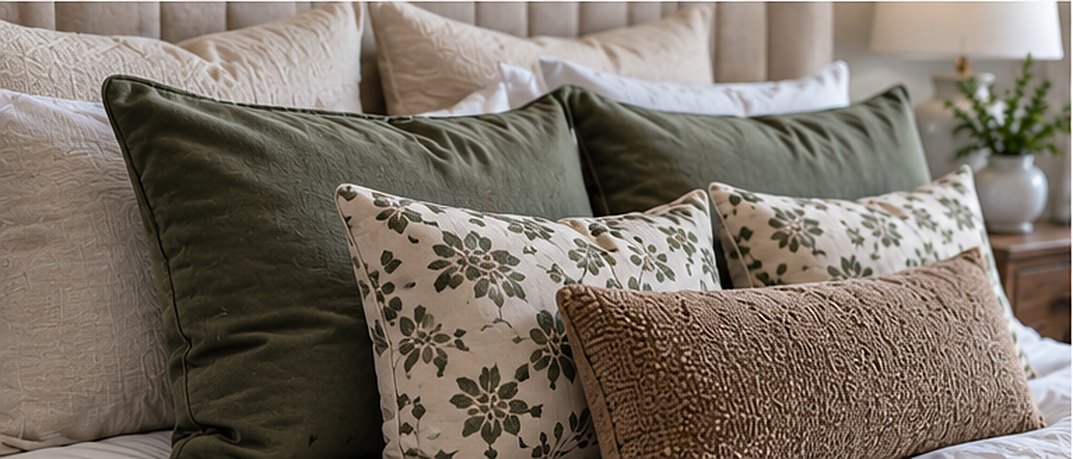
Up close, what makes this pillow stack work is texture, not color. There are only three colors in it, but every pillow feels different:
- Velvet in sage green, which catches the light.
- Printed cotton in a small green and cream floral, for a bit of pattern.
- A nubby, textured lumbar in tan, which warms the whole stack up.
If you're using solid colors, change the texture on every row. Linen next to velvet next to knit looks rich. Five cotton pillows in five colors just looks busy.
Don't forget the foot of the bed
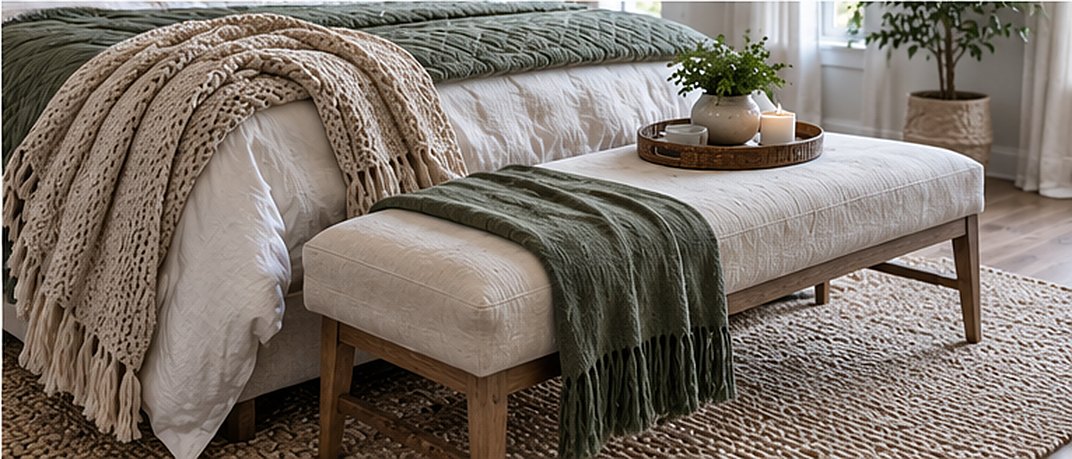
A bench at the foot of the bed finishes the look, and it's practical. It's where the throw goes at night, where the decorative pillows land when you go to sleep, and where you sit to put your shoes on.
I keep a second throw folded over one end, in sage to match the quilt, and a small woven tray with a plant and a candle at the other.
No room for a bench? A folded quilt on a chair in the corner, or a basket for the throw beside the bed, does the same job.
Four more fall bedding combos
Sage isn't the only way. These four all work, and each is easy to pull together.
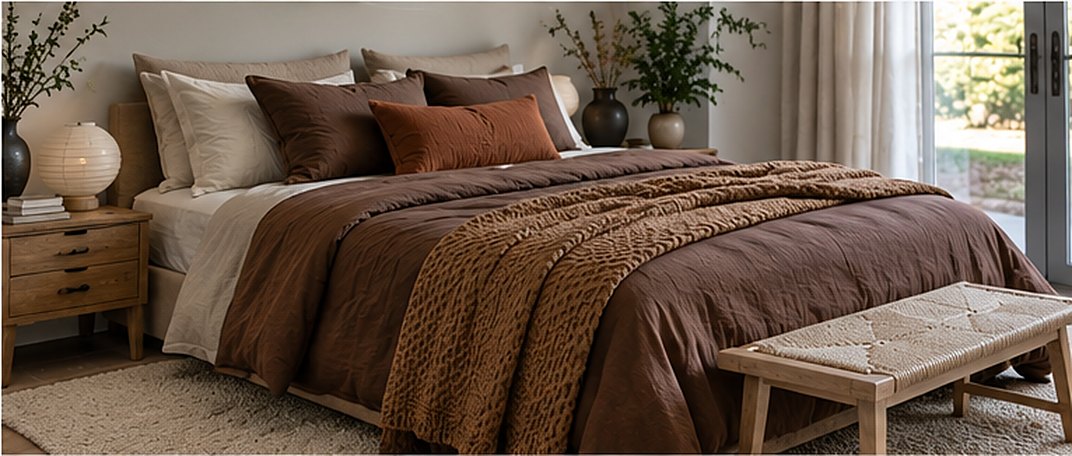
1. Brown and caramel. Chocolate brown linen duvet, oatmeal sheets, a caramel knit throw and pillows in cream, mocha and one rust accent. It's rich and warm, and it looks amazing with light wood.
2. Burgundy and ivory. Ivory sheets and coverlet, a deep burgundy velvet quilt folded at the foot, and a small plaid pillow in burgundy and cream. It's the most traditional of the four, and perfect with dark wood.
3. Rust and cream. A cream duvet, a rust linen quilt, and pillows in cream, rust and a warm terracotta stripe. It's bright and cheerful for early fall.
4. Green on green. A deep olive duvet with sage sheets and a moss green knit throw. It's calm and a little moody, and it looks great with plants.
The rule for all of them: one main color, one neutral, one texture. Everything else stays in the same family.
The 20-minute summer-to-fall swap
You don't need all-new bedding every season. This is my September swap:
- Keep the white sheets and the duvet. They work all year.
- Swap the light summer coverlet for a heavier quilt in your fall color.
- Change the pillow covers, not the pillows. Covers take up almost no storage space.
- Add the knit throw.
- Put the summer pieces in a breathable cotton storage bag, not plastic, so they don't smell musty in spring.
That's it. The inserts stay the same, and only the top layers change.
Keeping it on a budget
- Spend on the duvet insert and the sheets. You touch them every night.
- Save on pillow covers. They're inexpensive, and you can change them every season.
- Buy one good throw. A chunky knit throw lasts for years if you wash it gently.
- Shop fall bedding sets carefully. A bed-in-a-bag set is cheap, but everything matches too well. Mixing pieces looks more personal.
Care tips
- Wash the knit throw on a cold, gentle cycle, or by hand, and dry it flat.
- Wash velvet pillow covers inside out on cold.
- Air the duvet in the sun, or on a dry, breezy day, once or twice a season.
- Rotate pillow covers so one color doesn't fade faster.
Fall bedding FAQ
What colors are best for fall bedding?
Warm neutrals like cream, oatmeal and tan, with one fall color such as sage green, brown, rust or burgundy. Keep one color strong and the rest quiet.
How do you layer bedding for fall?
Sheets, then a duvet or comforter, then a quilt folded across the foot of the bed, then a throw draped over a corner. Finish with pillows, biggest at the back.
How many pillows should be on a bed?
On a queen, two euro shams, two sleeping pillows, two shams, two accent pillows and one lumbar. On a king, use three euro shams. You can drop the colored shams if it feels like too many.
What is the difference between a quilt and a coverlet?
A quilt has three stitched layers, with padding in the middle. A coverlet is usually thinner and lighter, sometimes only one layer. Either works folded at the foot of the bed.
How do I make my bed look cozy for fall?
Add texture. A chunky knit throw, a velvet pillow and a quilted coverlet make a bed look cozy even in simple colors.
Related reading
- Cozy bedroom ideas in olive green and cream
- Bedroom ideas that invite you to linger
- The linen bedding guide
- Fall centerpiece ideas with red berry branches
Strip the bed, pick one color, and layer it the same way every year. Some combos are worth repeating.