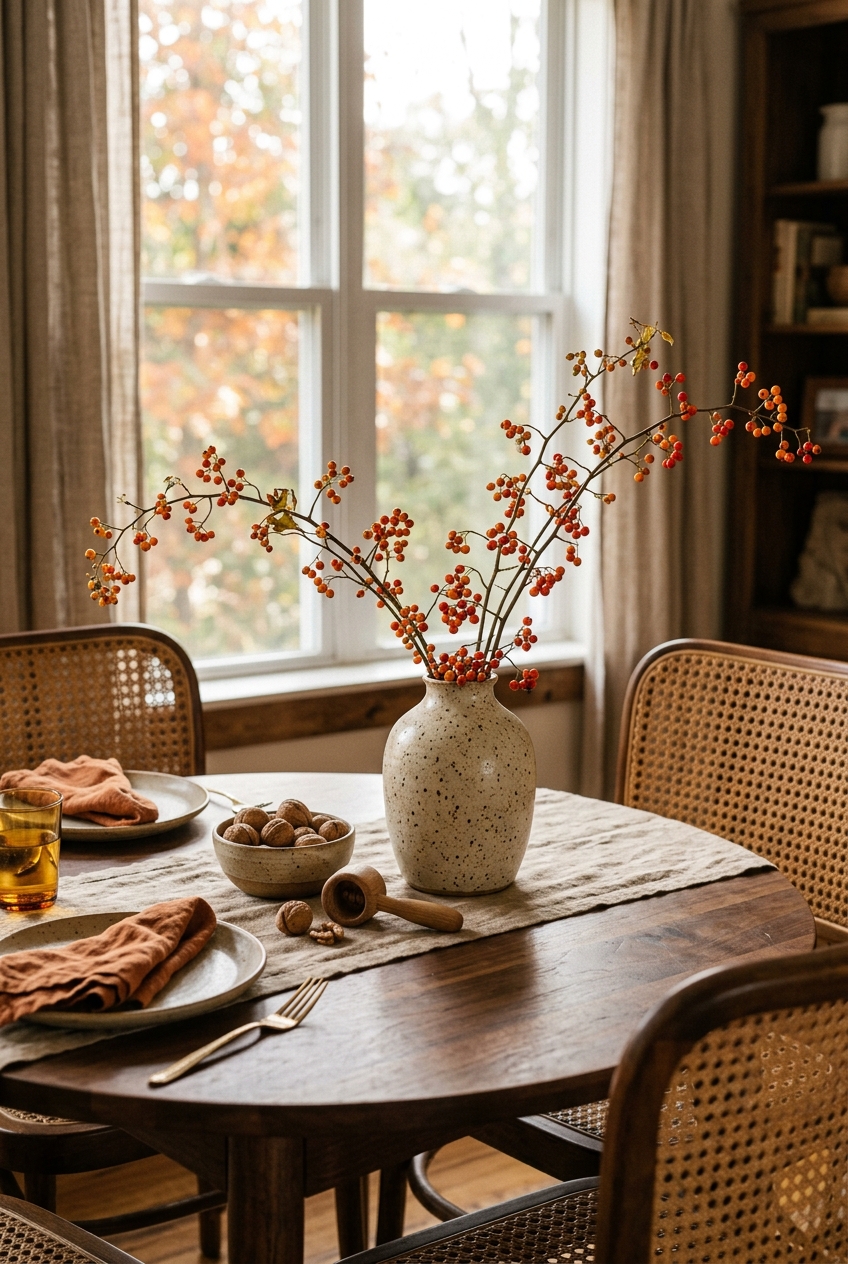
Three stems of something in one good ceramic vase. That's most beautiful fall centerpieces, honestly.
Big florist arrangements are lovely, but they're expensive, they block the view across the table and they die in a week. A single handmade vase with three arching branches looks more natural, costs almost nothing after the first year and lasts for weeks. Buy the vase once, change the stems with the season.
Choose the vase first
The vase is the part you keep, so pick one you love:
- Handmade stoneware with a speckled or matte glaze.
- A narrow neck so stems stand up without a frog or tape.
- About 8 to 12 inches tall.
- Heavy enough not to tip with tall branches.
Oatmeal, cream, brown and green glazes all suit fall.
Three stems, arching
Three stems look natural. Cut them at different lengths so they arch at different heights. Let at least one lean outward over the table.
Stems for fall
- Rose hips: red berries on arching stems.
- Crabapple branches with small fruit.
- Winterberry holly: bright red berries on bare branches.
- Dried oak or beech with brown leaves.
- Eucalyptus for a softer look.
- Bittersweet: see the note below.
A note on bittersweet
Bittersweet is a classic fall stem, but the common Oriental bittersweet is an invasive species in much of the eastern US, and birds spread its seeds from discarded arrangements. If you use bittersweet, choose native American bittersweet from a responsible grower, and bag and trash the stems afterward rather than composting them. Rose hips and winterberry give a very similar look without the worry.
A bowl of nuts beside it
A small bowl of walnuts, chestnuts or acorns beside the vase adds a second low element and makes the centerpiece feel complete.
Where to put it
- Round dining table: in the center.
- Kitchen island: at one end.
- Console or sideboard: off-center, with a lamp or books.
- Mantel: at one end.
Keeping stems fresh
Fresh-cut branches with berries last one to three weeks in water. Change the water every few days and recut the stems at an angle. Dried stems need no water.
Changing through the season
- September: eucalyptus or dried wheat.
- October: rose hips or crabapple.
- November: dried oak and a few pinecones in the bowl.
- December: winterberry and a sprig of pine.
Foraging stems responsibly
Much of the best fall material grows wild or in your own yard. A few guidelines:
- Cut from your own property, or ask permission.
- Never take from parks or protected land.
- Take a little from many plants, not a lot from one.
- Avoid invasive species or dispose of them in the trash, not compost.
- Use clean, sharp pruners and cut just above a leaf node so the plant heals well.
Arranging without a frog
With a narrow-necked vase, stems usually stay in place on their own. With a wider neck, crisscross a few pieces of clear tape across the opening in a grid, or put a ball of chicken wire inside. Both are invisible once the stems are in.
What it costs
- Handmade vase: $30 to $120, once.
- Stems: free from the yard, or $10 to $25 from a florist or market.
Mistakes to avoid
- Too many stems. Three is the magic number.
- All stems the same length.
- A vase with a wide mouth. Stems flop.
- Composting invasive bittersweet.
Fall vase arrangements FAQ
What do you put in a vase for fall?
Berried branches like rose hips or winterberry, dried oak leaves, eucalyptus or dried wheat.
How many stems in a vase arrangement?
Three stems of different lengths look natural and elegant.
Is bittersweet invasive?
Oriental bittersweet is invasive in much of the US. Choose native American bittersweet or alternatives like rose hips.
How long do berry branches last in a vase?
About one to three weeks with fresh water.