Staircase gallery walls are harder than flat walls for one reason: there's no level line to work from. The floor rises with every step, so measuring from the floor gives you nonsense.
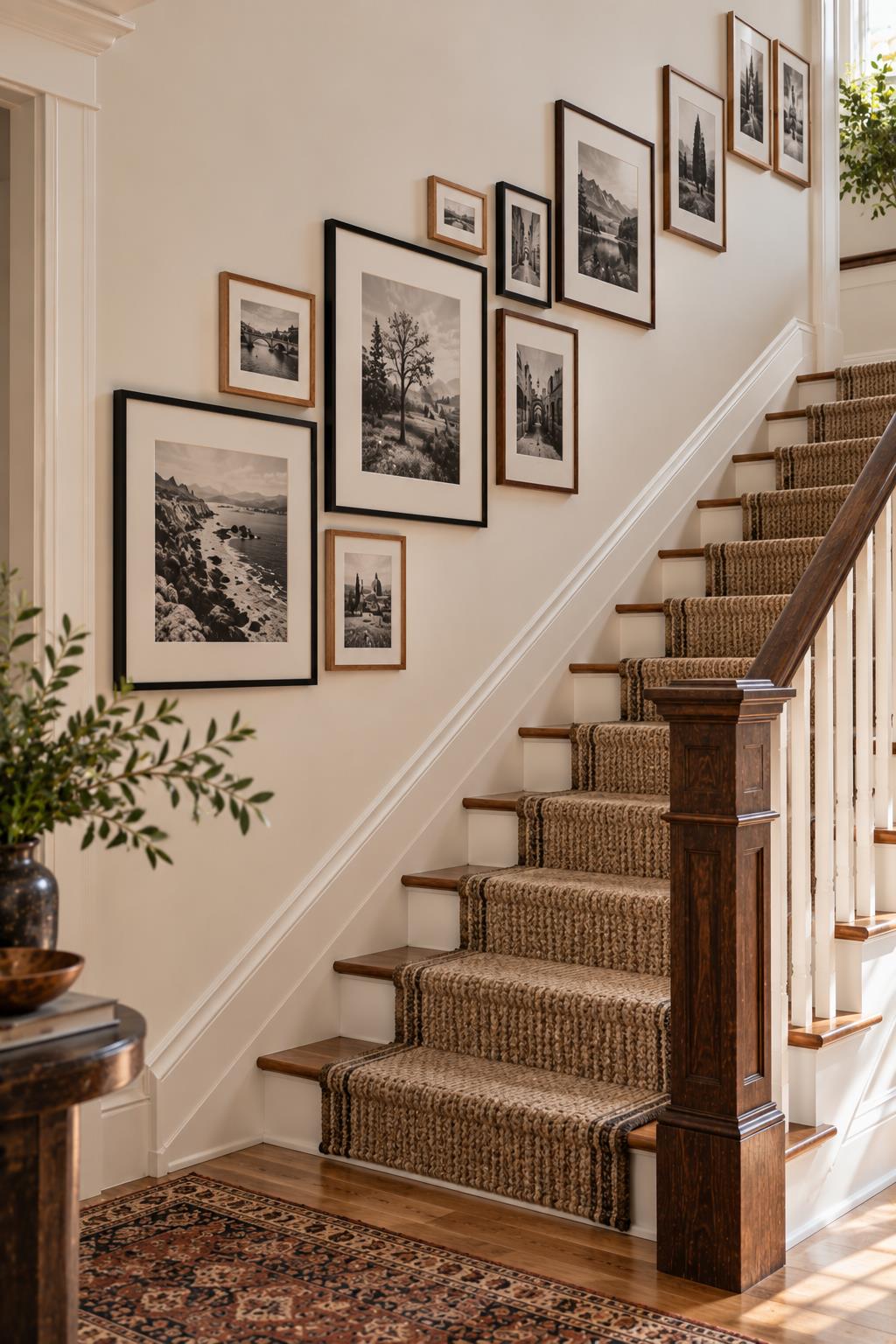
The trick is to follow the handrail. Hang the frames so their centers rise at the same angle as the rail, measuring from the stair nosing, the front edge of each step, instead of the floor. Once that diagonal line is right, you can mix frame sizes freely and it'll still look balanced.
Step 1: find your centerline
- At the bottom step, measure 57 to 60 inches up from the nosing and mark the wall.
- Do the same at the top step.
- Connect the two marks with painter's tape, using a long level or a straight board.
That tape line is the centerline your frames will follow. It'll be parallel to the handrail.
Step 2: plan the layout on the floor
Lay your frames on the floor in the order you want them, with even gaps of about 2 to 3 inches. Mix sizes: large at key points like the landing, small in between. Keep a rhythm, not strict symmetry.
Step 3: templates on the wall
Cut paper templates for each frame and tape them along the centerline, centering each one on the line. Walk up and down the stairs a few times. Adjust until it feels right.
Step 4: hang
Nail through the templates at the hook marks, tear off the paper, hang the frames. Use two hooks on larger frames to keep them level.
Mixing frame sizes
- Anchor frames: use the largest at the bottom, the middle and the top.
- Fill frames: smaller ones in between.
- Stack small frames two high in places to vary the rhythm.
Black and oak frames mixed together work well if you repeat each color along the length.
A sample layout for a straight flight
For a standard 13-step straight staircase, this layout works well:
- Step 2: a 16x20 frame.
- Steps 3 to 5: two 8x10 frames stacked vertically, then an 11x14.
- Step 6 or 7 (middle): another 16x20, the visual anchor.
- Steps 8 to 10: an 11x14, then two 5x7s stacked.
- Step 11 or 12: a final 16x20.
Every frame's center sits on the diagonal line. The large frames at the bottom, middle and top give the eye three resting points.
Keep the content consistent
Black and white photographs or a consistent color treatment tie mixed frames together. On a staircase, the eye moves quickly, so consistency matters more than on a flat wall.
Handling a landing
If your stairs turn at a landing, treat the landing wall as a separate, level mini-wall. A single large frame or a small grid there, then pick up the diagonal again on the next flight.
Lighting
Stairs are often lit by one overhead light. A few picture lights or a wall sconce halfway up improve safety and make the photos glow.
Safety
Keep frames flat to the wall and hang them securely; people brush against stair walls. Avoid heavy frames over the handrail side.
What it costs
- 8 to 12 mixed frames: $150 to $500.
- Printing: $30 to $120.
- Tape, paper and hooks: under $30.
Mistakes to avoid
- Measuring from the floor. Measure from the stair nosing.
- Frames not following the rail angle.
- All the same size frames. A staircase benefits from rhythm.
- Hanging too high. Keep centers at 57 to 60 inches above each step.
Staircase picture frame layout FAQ
How do you lay out pictures on a staircase wall?
Mark a diagonal centerline 57 to 60 inches above the stair nosing, parallel to the handrail, and center each frame on it.
How high should pictures be on a staircase?
Centers 57 to 60 inches above the nosing of the step below.
Should staircase frames be the same size?
Mixed sizes work well as long as they follow the same centerline and repeat frame colors.
How far apart should staircase frames be?
About 2 to 3 inches.